
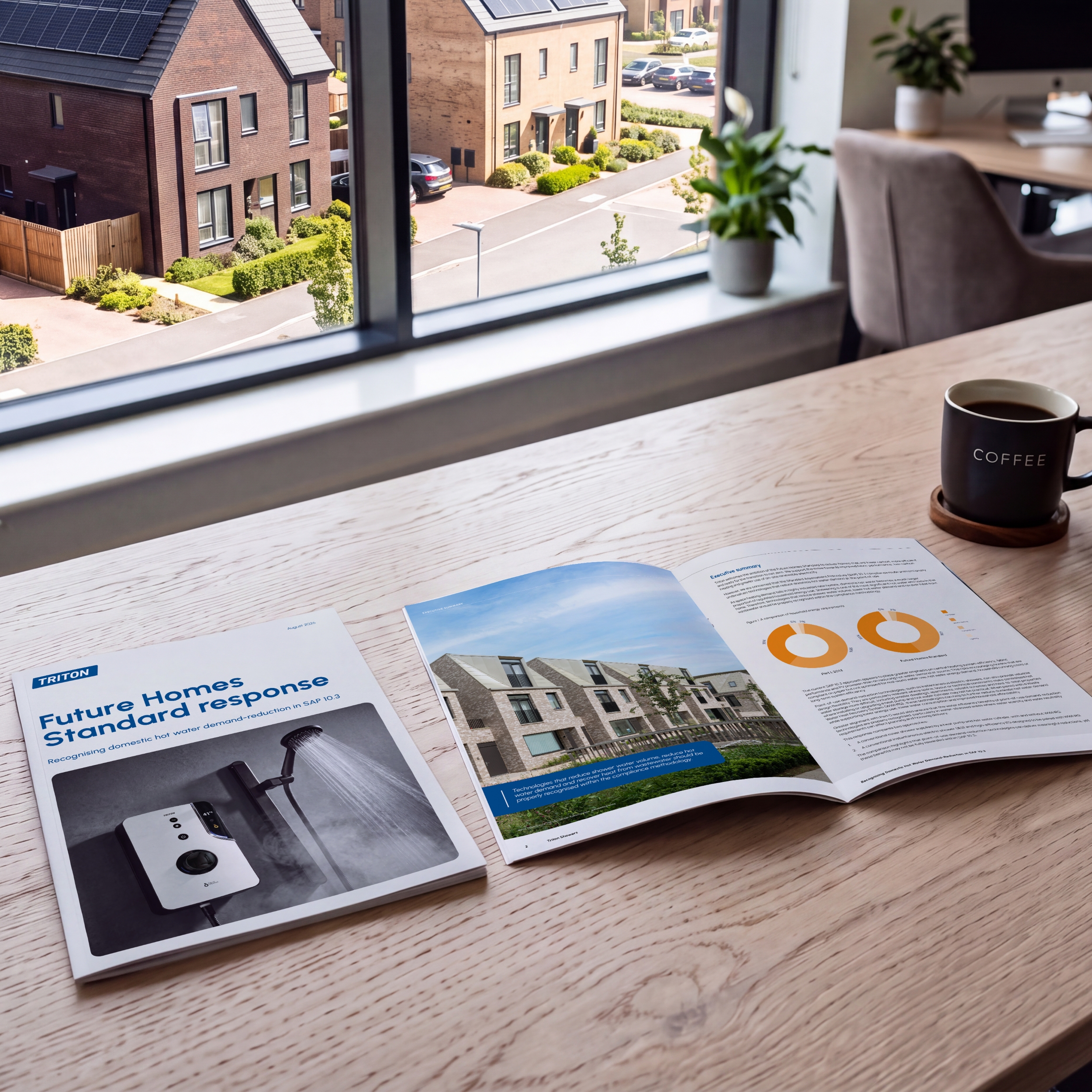
Standard Assessment Procedure (SAP) methodology may undervalue technologies that reduce hot water demand at source, despite growing pressure to improve household efficiency and cut energy use.
The Future Homes Standard compliance framework could miss an opportunity to further reduce household energy consumption, water use and running costs if domestic hot water (DHW) demand-reduction technologies are not properly recognised, according to experts.
A new report from Triton Showers, Recognising Domestic Hot Water Demand-Reduction in SAP 10.3, explores how the SAP 10.3 methodology treats DHW, which is expected to represent a significantly larger proportion of regulated household energy use as space heating demand falls in highly efficient, low-heat-loss homes constructed under the Future Homes Standard.
It claims the current SAP 10.3 approach appears to place greater emphasis on central heating system efficiency, fabric performance and photovoltaic (PV) provision than on reducing DHW demand at source. It suggests this risks encouraging homes that are compliant on paper but not fully optimised for hot water demand, water consumption and long-term system efficiency.
DHW is expected to make up a larger share of household energy demand as new homes become better insulated and require less energy for space heating. Showering remains one of the most significant uses of DHW, making it an important area for improving efficiency and reducing consumption.
The report examines the benefits of specifying the latest shower demand-reduction technologies, including high-efficiency instantaneous electric showers and waste water heat recovery systems (WWHRS):
The research assesses four shower-system configurations:
- A conventional mixer shower supplied by a heat pump and hot water cylinder
- A conventional instantaneous electric shower
- A mixer shower paired with WWHRS, supplied by a heat pump and cylinder
- An instantaneous electric shower designed to be paired with WWHRS
Based on standard SAP assumptions and two daily showers, the report estimates choosing an instantaneous electric shower paired with a WWHRS could reduce annual shower-related energy use by 35.1%, potable water consumption by 41.6%, carbon emissions by 36.7%.
Annual combined energy and water costs, meanwhile, would drop by £137 compared with a conventional mixer shower supplied by a heat pump and hot water cylinder.
Paul Ravnbo-West, market development manager at Triton Showers, said: “The Future Homes Standard is a welcome and necessary step forward in the transition to low-carbon homes. While it will play a crucial role in reducing space-heating demand, there must also be a plan for the next major source of regulated household energy use: domestic hot water.
“The framework should do more to encourage homes to reduce hot water demand, but the proposed compliance methodology does not currently provide sufficient recognition of technologies that reduce demand at source.”
Triton argues that instantaneous electric showers paired with WWHRS could be particularly relevant in hard-to-treat properties and smaller homes, including apartments, where space constraints, layout limitations or cost considerations can make the specification of a heat pump and hot water cylinder more challenging.
The manufacturer has identified seven practical policy levers that could help SAP 10.3, the Home Energy Model (HEM), and future home-energy frameworks better recognise domestic hot water demand reduction.
Recommendations include introducing a dedicated domestic hot water demand-reduction metric so that compliance rewards homes for requiring less hot water, as well as closer alignment between SAP 10.3, HEM and Part G to recognise the combined water, energy, cost and carbon benefits of demand-reduction technologies. The report notes that SAP 10.3 currently excludes the costs and operational emissions associated with mains water supply and wastewater treatment.
Paul continued: “Point-of-use demand-reduction technologies like high-efficiency electric showers paired with WWHRS are exactly the type of practical, scalable innovation that should be encouraged under the Future Homes Standard.
“Our recommendations are intended to help policymakers ensure new homes are designed not only to generate heat efficiently, but also to use less hot water in the first place. This approach could help lower household bills, reduce pressure on water resources and provide more flexible compliance pathways for developers, particularly in hard-to-treat properties.”
Download Recognising Domestic Hot Water Demand Reduction in SAP 10.3.
Triton Showers is a Industrial Associate of CIPHE, to see the full list of associates check out the CIPHE industrial associates directory