
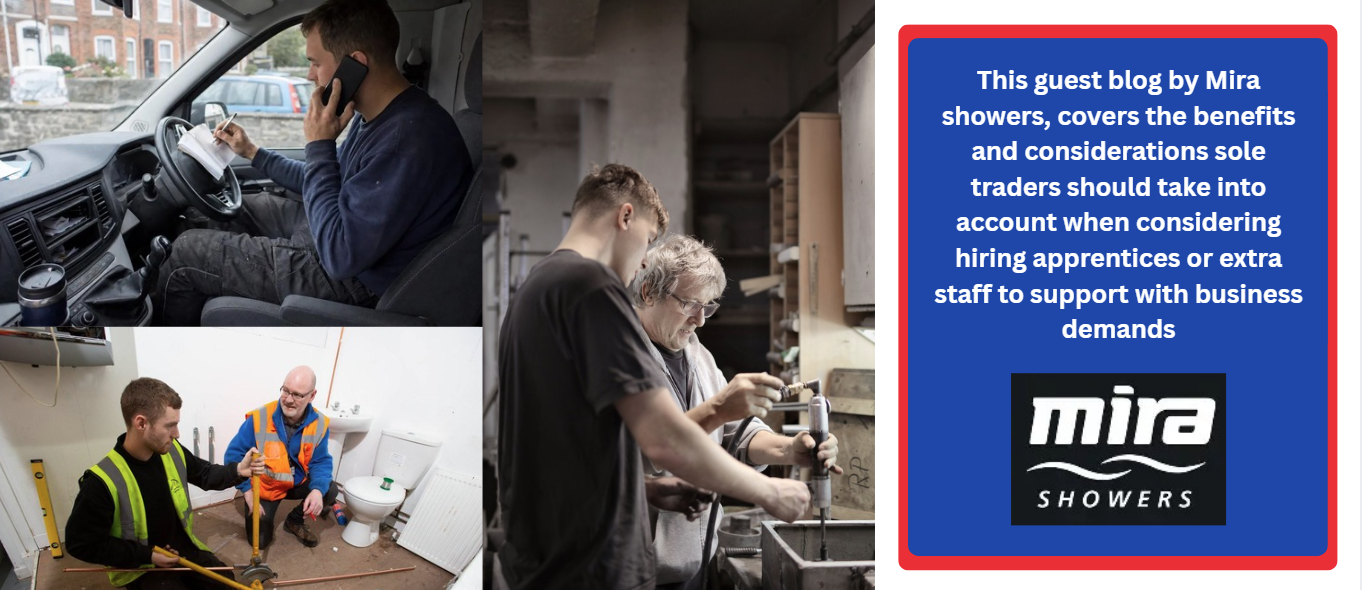
The diary’s full. But the phone doesn’t stop ringing.
You’re working longer days than you meant to. But there comes a point where there literally aren’t enough hours in the day. You want to push on, but a thought creeps in: “I can’t physically do any more of this.” Most plumbers end up in this situation.
This is usually when the idea of hiring someone pops up. An extra pair of hands. A way to take on more work. They always say you’ve got to speculate to accumulate, and it’ll give you a bit of breathing space.
But there’s more to it than that. More people doesn’t always mean more breathing space. It means more responsibility, more risk, more complexity, more moving parts. Being a sole trader and being an employer are two very different things.
So how do you know if it’s the right move or if you’re better off staying solo?
Are you actually at capacity?
Before you even think about hiring, it’s worth asking yourself a blunt question: are you maxed out, or could you improve your organisation?
Do you find you are often double‑booking, constantly running late, feeling under pressure even with gaps in the diary, saying yes to everything ‘just in case’ and staying up late into the night doing quotes?
Or are you saying no to less suitable jobs, or pricing differently to give you the breathing space you need. Maybe you’re consistently booked weeks in advance, turning away solid work and still feeling stretched, that might be a sign to start looking at growing your workforce.
There are a lot of variables. But before you start thinking about hiring, be honest with yourself… could you be better organised?
After that, you need to think about the realities around the cost of hiring.
The cost of hiring is more than just wages
It’s easy to think that if you pay someone £30k a year, then anything on top of that is profit.
Unfortunately, it doesn’t work like that.
You may already be in this position. You may know the hidden costs behind expansion. But if you’re navigating this path for the first time, you won’t be the first, or the last, to find it confusing. Because the real cost of hiring is more than what you pay them, there’s also:
- National Insurance contributions
- Pension contributions
- A van (and fuel, insurance, maintenance)
- Tools and equipment
- Insurance cover
- Training and supervision time
- Admin, payroll, paperwork
Add it all up, and a £30k employee might realistically cost you closer to £40–45k+ per year.
So the real question quickly becomes, can that person reliably generate more than this in income, consistently?
The hidden cost: your time and headspace
Money is only part of the equation. The bigger shift is how your day looks.
When you’re working solo, your focus is simple. You do good work. Get paid. Move on.
But when you hire someone, your job changes. You’re checking their work, answering their questions, dealing with errors and mistakes (everyone makes them). You’re planning jobs, but for a team, not just yourself.
You’re no longer just an installer. You’re managing people,and some people love that shift. But others don’t. So, you need to be honest with yourself: do you want this burden?
You don’t have to jump straight into full‑time hiring.
One mistake people make is assuming it’s all or nothing. Staff or no staff.
But you could hire subcontractors, as and when you need them. This can give you more flexibility without the long-term commitment. They also don’t use PAYE. They’re responsible for their own tax, though usually you’ll make deductions from their payments. But it’s still one less thing for you you to worry about.
You can find a helpful guide to handling and paying subcontractors here.
Then there are apprenticeships. But that’s a different question entirely.
What it really costs to take on an apprentice
On paper, apprentices look like a low‑cost way to grow your business. Compared to hiring a fully qualified plumber, it can seem that way.
But they’re not cheap labour, they’re a long‑term investment.
Wages are lower, especially in year one. Training costs are mostly covered by government funding and National insurance contributions are zero if the apprentice is under 25, on an approved apprenticeship standard or framework and earning less than £967 per week.
But there’s more to it.
The not-so-obvious costs
In the early stages, an apprentice won’t speed you up.
You’ll be explaining jobs step by step, checking their work, fixing mistakes, teaching and adjusting your pace to accommodate them. Unless they’re a plumbing prodigy, they’re not a cheap pair of hands.
Then you’ve got other upfront costs like insurance cover, admin and coordination with training providers. Nothing huge individually, but when the margins are razor thin, it all adds up.
Apprentices have long been the lifeblood of the trades; it’s the route we all take.
It offers a structured way to train and upskill people who often stay with you. If you’re thinking about succession planning in the future, the role of apprentices should be part of your thinking.
But, do consider the time investment you will need to make.
Whether that’s worth it depends on whether you’re thinking about next month’s workload or the next five years and beyond.
There could be another way.
There could be another solution. Another path you may not have considered.
If you want to grow your business, expand your empire, so to speak. Then, at some point, hiring new tradespeople is inevitable. There’s a certain point where you simply can’t go it alone.
If you’re thinking about hiring not just to grow, but to alleviate the pressure, then another tradesperson in the mix doesn’t guarantee that. It could just make things more complicated.
But you could hire someone to administer or project manage in the business.
You want to be running a successful business, you want to be busy and working, and you want to be on the tools. But the burden of managing diaries, invoices, job quoting and client comms is what’s keeping you awake at night.
So hire someone to do that instead.
Someone who can take away the administrative burden, so that you can remain the practitioner you want to be.
In summary
The question isn’t simply whether you should hire or stay solo. It’s what kind of business you actually want to run. It’s also understanding what the pressure you’re feeling actually means.
Because it might not always mean you need more people on the tools. It could mean you need better systems, different kinds of support, or maybe genuine expansion.
But each path carries its own costs, commitments and changes to your day-to-day role. It’s not as straightforward as hire and watch the pressure drop.
Hiring can accomodate growth, but it can also introduce complexity that doesn’t always ease your load. It just presents different burdens. While apprenticeships on the other hand are rarely, if ever, an answer to alleviating workload.
Sometimes the smarter move is to stay lean, refine how you work or bring in the right kind of help at the right time. That doesn’t always mean bringing in more people on the tools, you can hire across other parts of the business to provide support and alleviate pressure.
Ultimately, it’s about making a conscious choice; not chasing growth for its own sake, but building a business that fits your vision.